Meet the person. Not the profile.
Kindred is a dating and friends app with no photos for the first three days. You talk first, you both see on day 3, and it helps you meet in the first week. It is starting in Toronto.
Free for everyone, always — the full app, every feature. Starting in Toronto and the GTA, and it runs in your browser with nothing to download.
Nothing else does this
Real screens, from the real app.

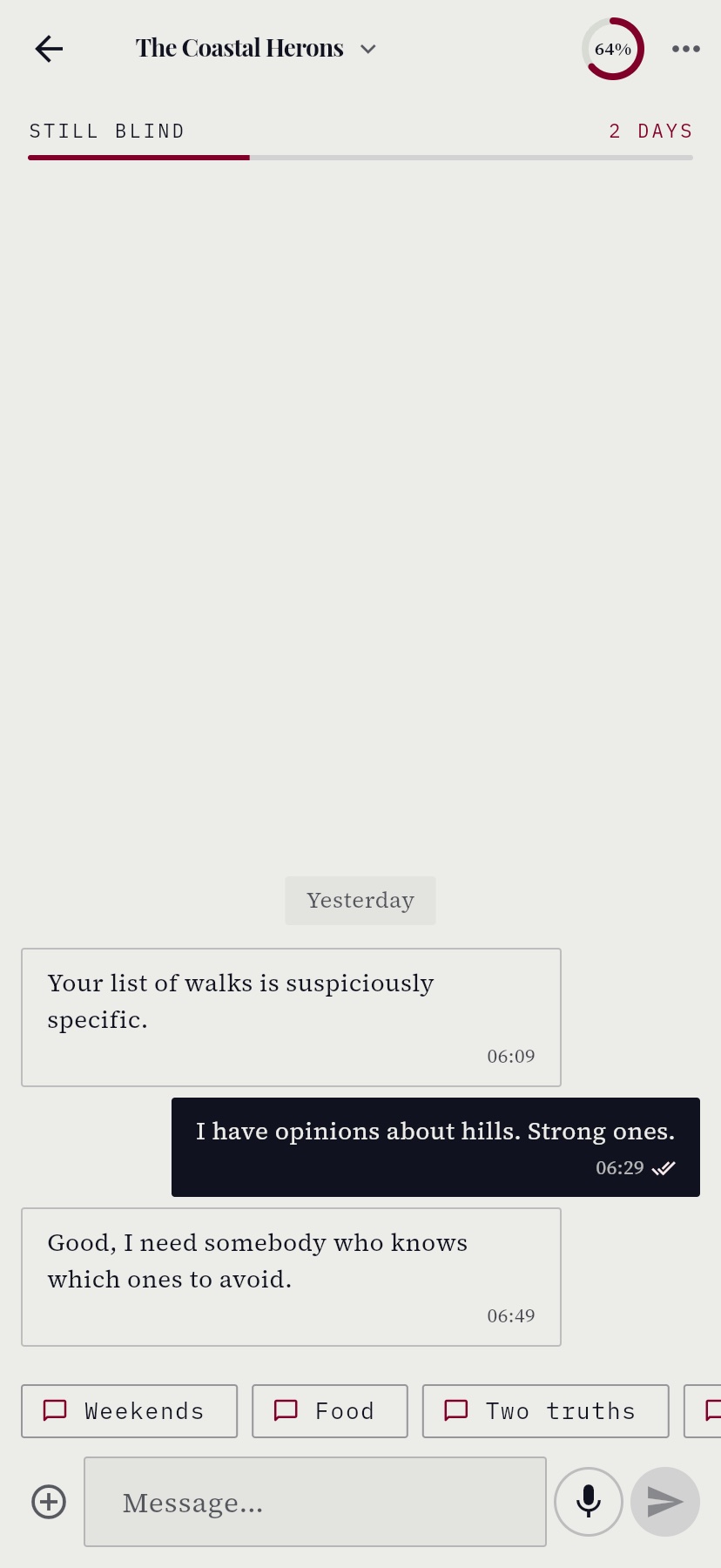
Three days of talking, then photos and names unlock for both of you in the same second. Nobody sees first.

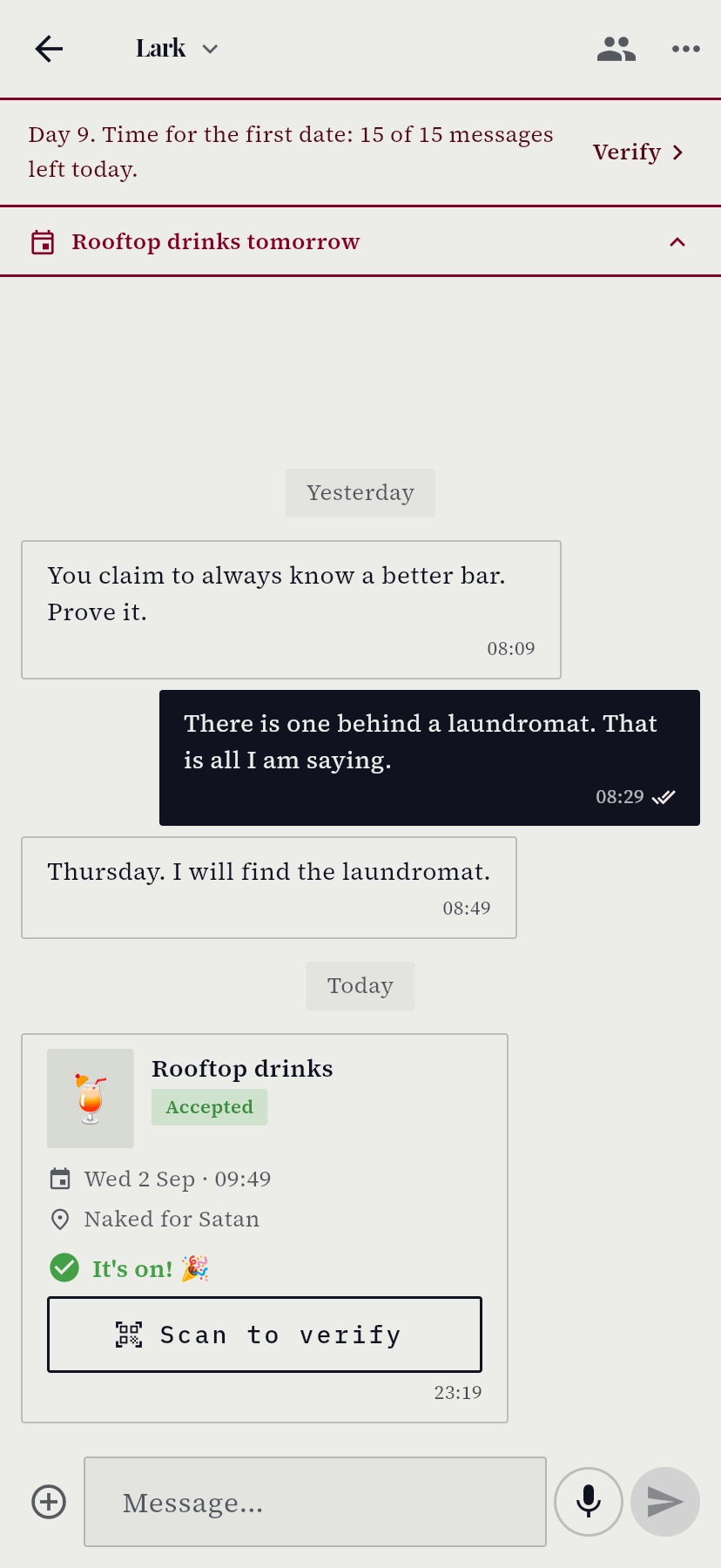
On day 7 it asks you both to name a day, and until you meet you get an allowance rather than unlimited chat. Conversations with no reason to advance die in about four days.

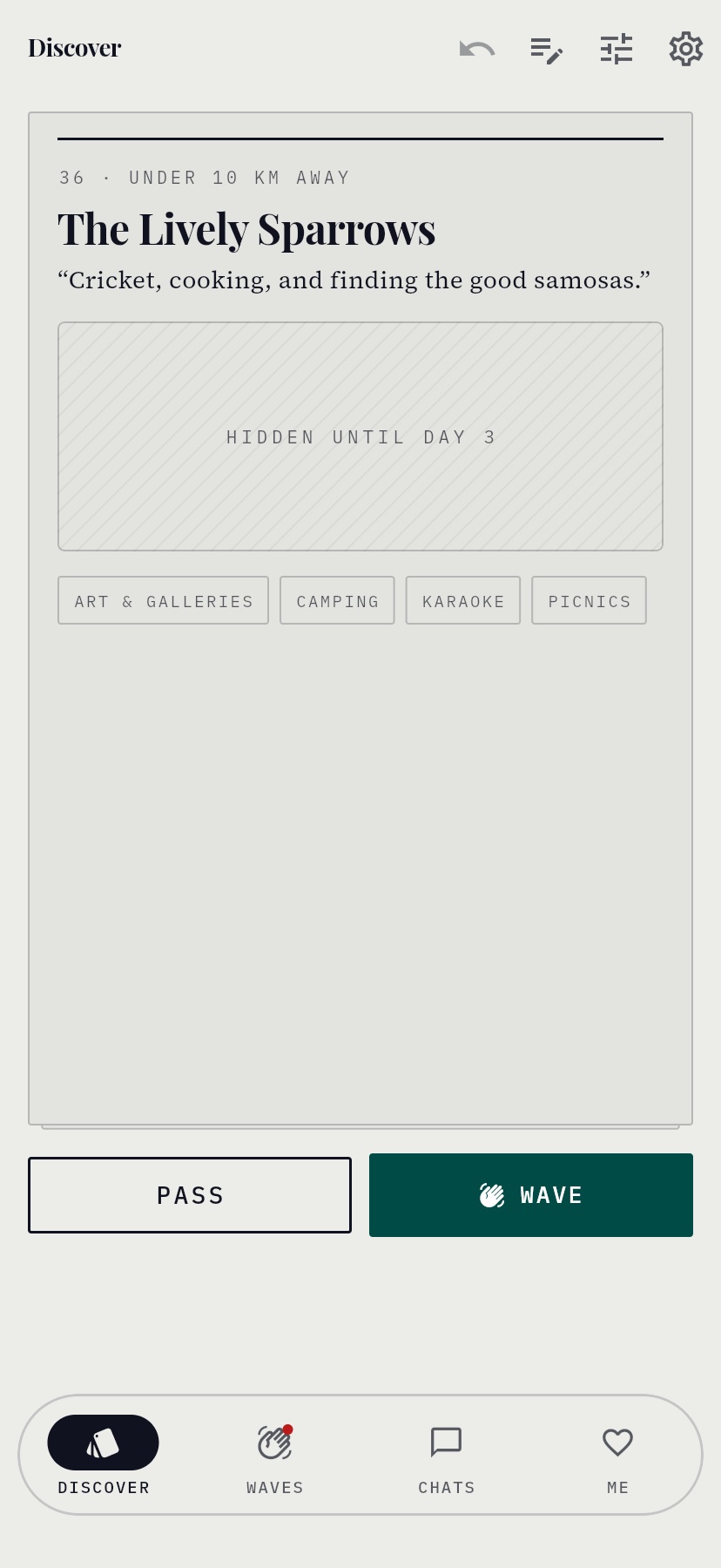
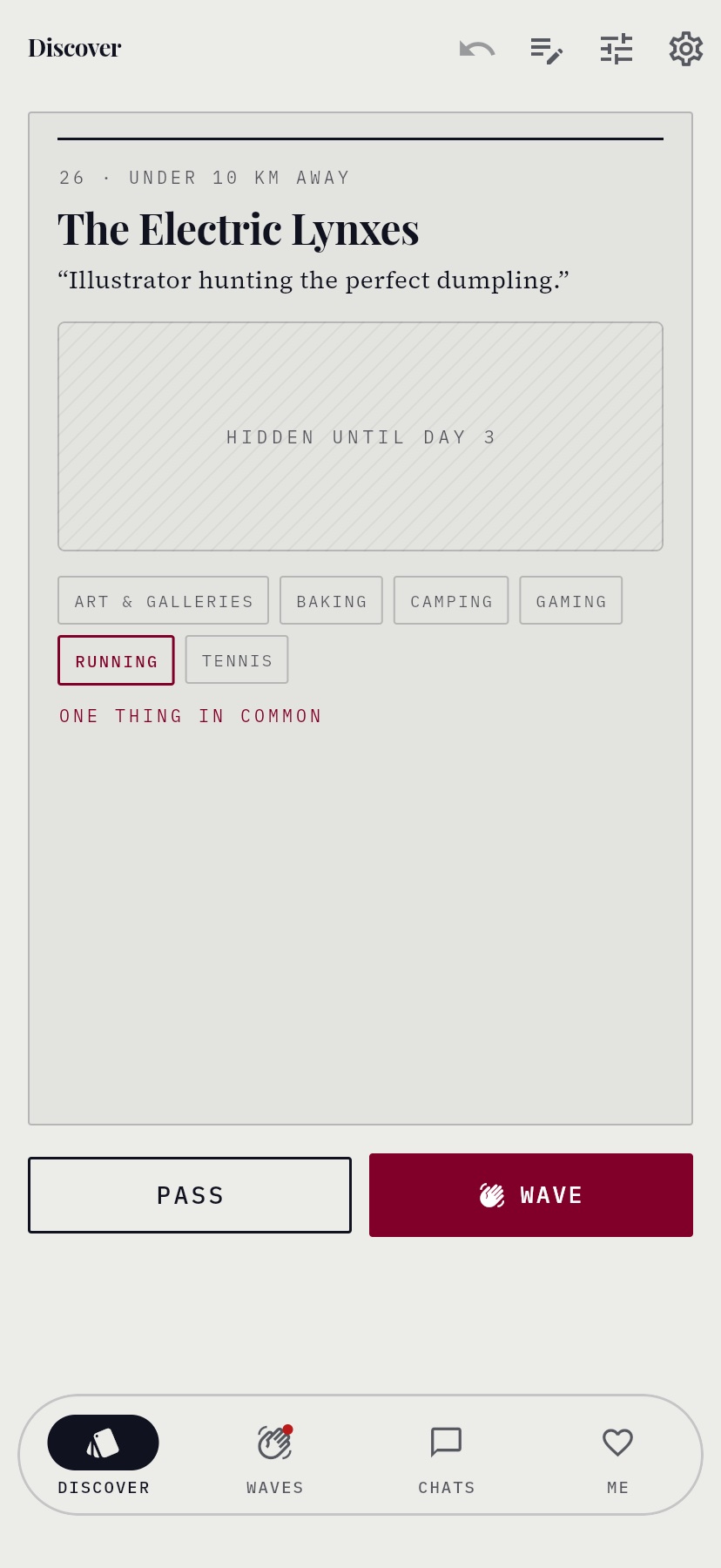
Interests, roughly how far away, and what somebody wrote about themselves. You decide on a person, not a photograph.

Dating, friends, and couples looking for couples. You pick one when you join, and your deck only ever holds your own room: somebody in friends mode is never dealt to anybody looking to date, in either direction. The map is the one shared space, and every pin says which room it came from.
Free for everyone, always. The full app, every feature, no card.
New
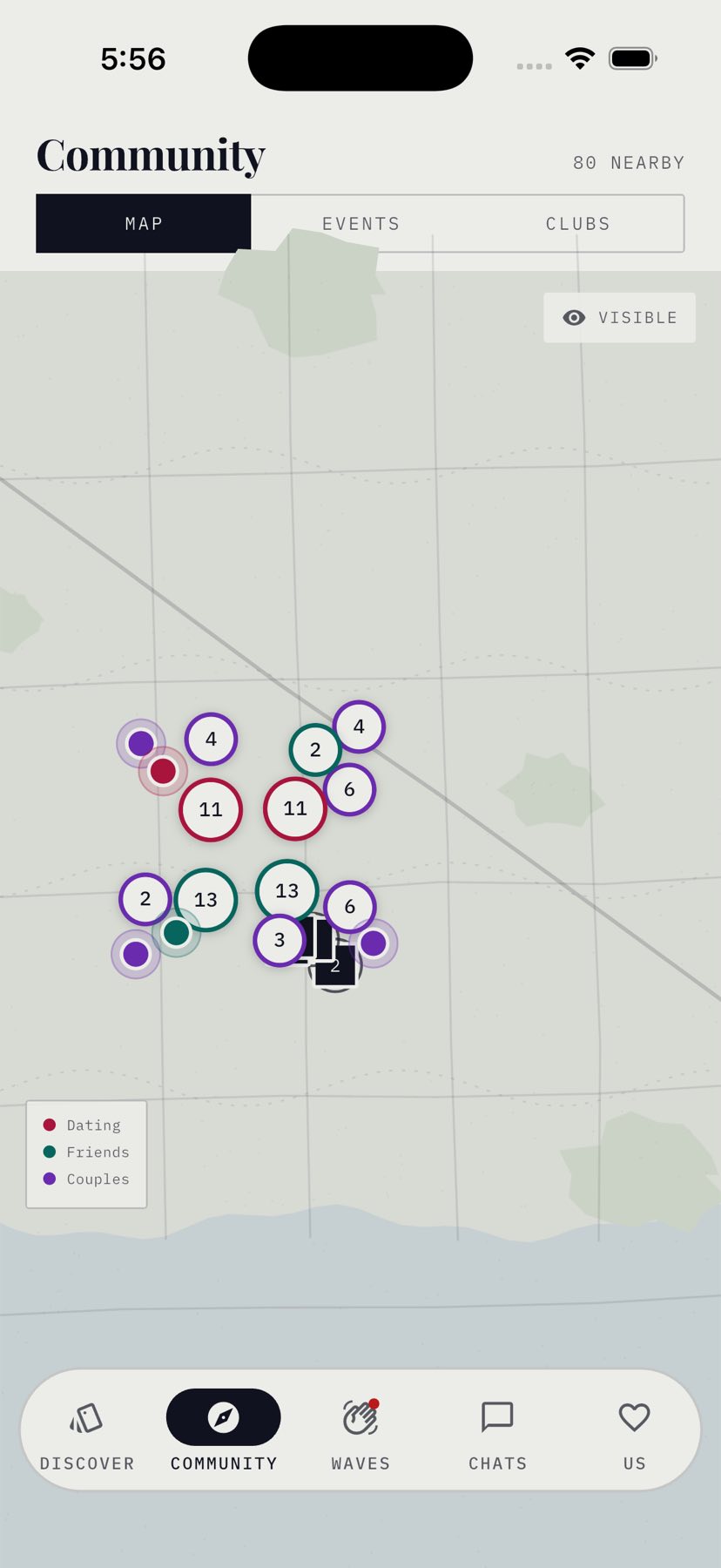
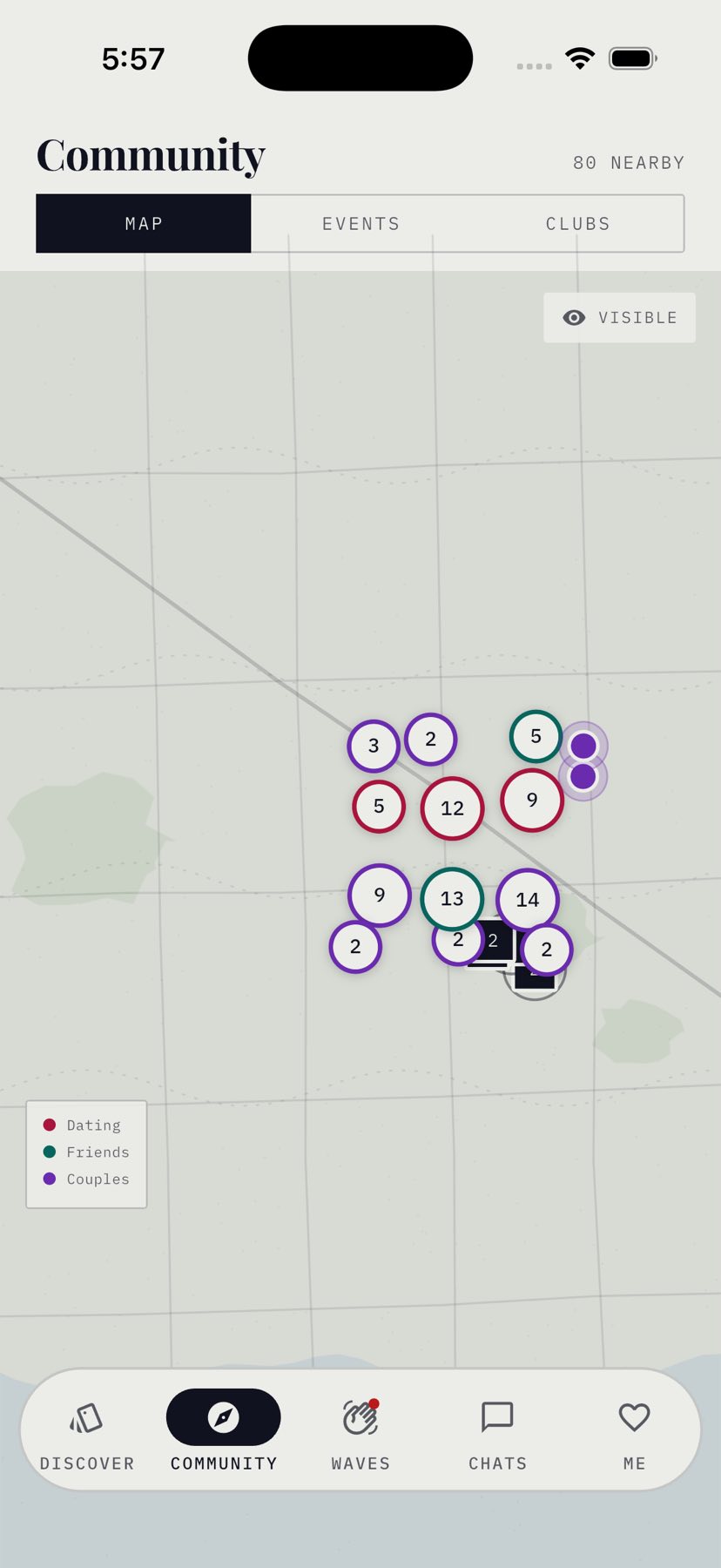
A real map of your city with real cafes, parks and bars on it. See who is about, post something to turn up to, or join a club that keeps meeting.

Every coloured dot is a person, and the colour says which of the three rooms they are in. Where several are close together they gather into a numbered bubble you can open. The circled icons are real places — cafes, bars, parks — and tapping one shows what is already happening there.

Every pin is moved to a random point a few hundred metres from where that person really is, and that offset is held for hours — so watching one all afternoon tells you nothing a single glance did not. One tap takes you off the map completely.
Two kinds. Right now — “I am at this beach for the next two hours” — which clears itself after four hours, because a map of people who went home an hour ago is worse than an empty one. Or planned, for a day and a time, which people can ask to join until it starts. Pick a real cafe or park for it, and it appears there on everyone’s map.
This is the only way to reach somebody from the map. There is no message button anywhere on it. You ask, the host says yes or no, and that is the whole of it. No inbox to fill, nothing to ignore, nobody arriving in your messages because they saw a dot near their street.
When a host says yes, the two of you get a chat that lasts twelve hours — long enough to agree a corner and a time, not long enough to become another conversation that goes nowhere. Meet up, scan each other’s code, and if you both say it went well it becomes a proper chat. If you never meet, it disappears and leaves nothing on either profile.
Clubs keep meeting — a run club, a supper club, five-a-side, a book group. Events happen once. Anyone can start either in about a minute, decide whether to approve people or let them straight in, and cap the numbers if the table only seats six.
Every club and every event gets its own page, and on it a wall: a members-only feed where the organiser posts announcements — “we are meeting at the gate this week, the path is closed” — and everybody else can talk. Announcements sit at the top; everything else runs underneath.
It is members-only in both directions. People who have not been approved cannot read it, and nothing posted on it appears anywhere else in Kindred.
Joining a club does not show anybody your face. Members see each other as the same blind cards as everywhere else, and photographs unlock the usual way: three days, or a meetup you both rated. Only the organiser sees full profiles, because they are the one deciding who turns up to something they are responsible for.
Free, like the rest of it. No ads, no tracking, no paid tier.
In plain words
Kindred helps you meet people near you who like the same things you like.
You do not see photos at first. You see what someone is into, roughly how far away they are, and a few lines in their own words. If you both say yes, you start talking.
On day 3, you both see names and photos at the same moment. Nobody sees the other person first.
By day 7, the app helps you sort out a real plan: what to do, where, and when.
You can use it as a couple looking for other couples, on your own looking for friends, or on your own for dating. You pick when you sign up.
No photo. No name. Just what you both like doing, and how far apart you are.
Names and photos appear for both of you at once, after you have already talked.
The app helps you pick a plan. When you meet, you scan each other's code to confirm it happened.
Who it is for
Making friends as a couple is hard, and almost nothing is built for it. Kindred matches the two of you with other couples for dinners, hikes and games nights. Friends only, and we enforce that.
New town, new job, or your friends all moved away. Match on what you like doing and when you are free. Nothing romantic anywhere in it.
The same idea, for dating. You find out if you actually get on before you find out what anyone looks like.
Why it works
Other apps show you a photo before anything else. So you judge people in half a second, on the one thing that has the least to do with whether you would enjoy their company.
Then you match, chat for three weeks, and never meet. Nothing is pushing the conversation anywhere. And someone who could have been a great friend gets swiped away because of one bad photo.
Kindred turns that around. You match on the things you both like doing. Photos come later, once you have actually talked. And the app keeps asking the question that matters: when are you two going to meet?
A photo does not tell you whether you would enjoy a Saturday with someone. What they like doing tells you a lot.
Photos on day 3. A plan by day 7. A chat cannot quietly drift for three weeks and die on its own.
You already know one thing you both like. That is what you open with, instead of staring at an empty box.
Ghosting
On every other app, letting a conversation rot is free. Nobody is told, nothing ends, and the easiest thing to do is nothing. That is the machine that makes ghosting, and Kindred is built the other way round.
Not a private nudge to one of you. The same warning, at the same time, to both. It takes away the part that actually hurts, which is not knowing whether the other person noticed.
Any message resets the clock to zero. Nobody has to do the ending, which is the entire reason endings do not happen. It is simply over, and you both know.
It asks you both to agree a day, a place and a time, so neither of you has to be the brave one. "We should meet up" is not a plan. "Thursday at seven" is.
Fifteen messages a day each after day 7, with anything about arranging the meetup free. It is the app declining to be a substitute for the thing you came here for.
The clock never runs while you are still blind: it starts on the first message, or on day 3 if neither of you has spoken, so nothing can die before it has been used. And the moment you actually meet and scan each other, every one of these timers stops for good. Real friendships go quiet for a fortnight and come back; an app that killed them for it would be worse than useless.
None of it is a paid feature and none of it can be switched off. The full rules, with every number.
What is different
Side by side with how these apps normally work.
Watch it work
Both of you sign up, each with your own email. Pick what you like doing and when you are free.
You see couples nearby who like the same things. No photos, no names.
Send a wave about something you both enjoy, like board games or hiking.
Chat for three days and photos unlock. Then plan a night out together.
What you like doing, and the evenings and weekends you are usually free.
People who like the same things, close to you. No photo, no name.
Open with something you have in common instead of a blank message box.
Three days of talking unlocks photos. Then you make a plan.
Your interests, your free time, and who you want to be shown.
People who like what you like. You will not see a photo yet.
A wave about a shared interest. Much easier than opening with nothing.
On day three you both see photos. By day seven, a first date.
What it costs
The full app, every feature, for everybody. There is no free tier and no paid tier, because there is only one tier: no paywall, no subscription, no card, nothing held back and nothing to cancel.
No card, no trial, no limit.
Some things are not available at all, to anybody: seeing a photo or a name before day 3, anyone's exact location, and how somebody rated a meetup with you. That was true when there were tiers and it is true now.
Meeting up
Every app says it wants you to meet people. Kindred is built for the part after you agree to.
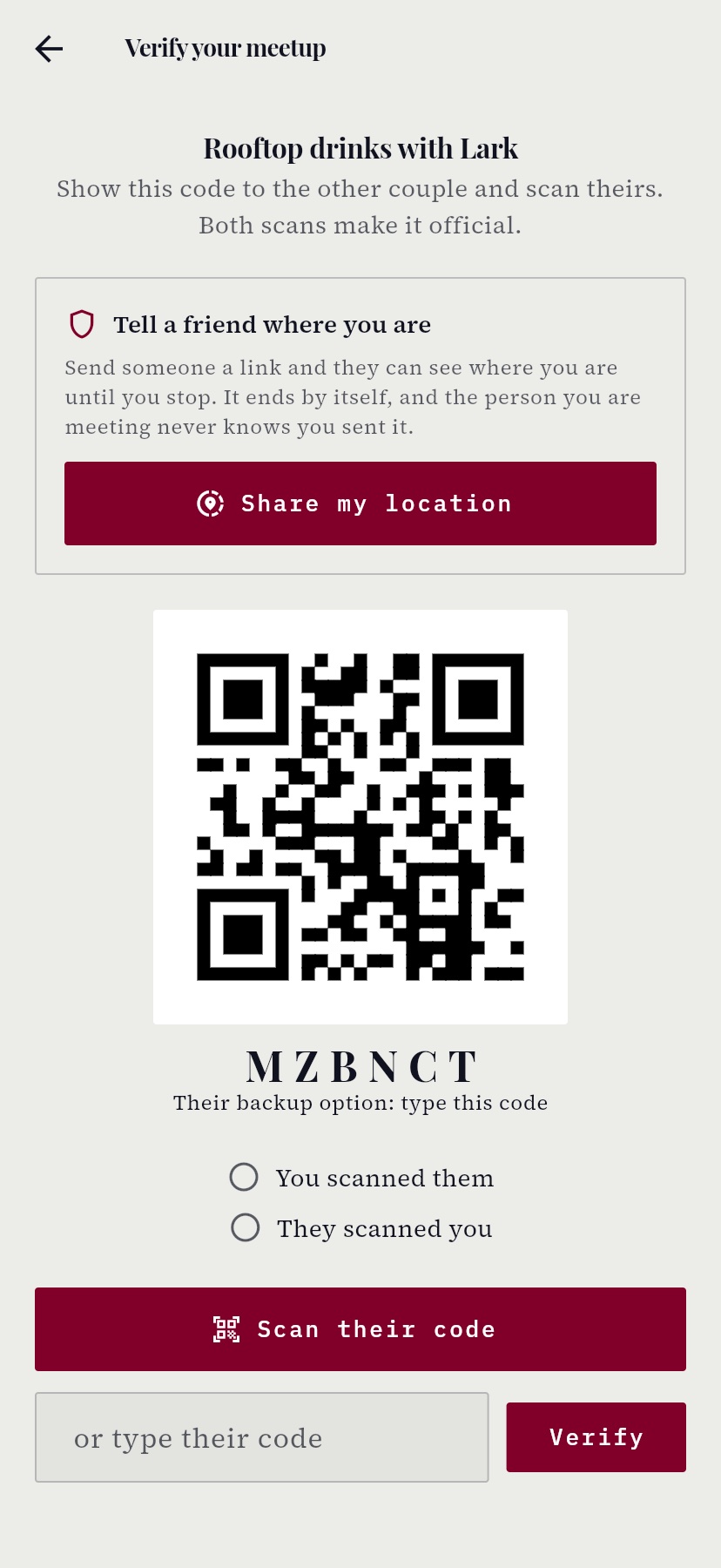
When you meet, you each show a code and scan the other one. That is what confirms the meetup happened.
It cannot be done from home, and it cannot be faked by one person, because it takes both phones in the same place at the same time. So a confirmed meetup on Kindred means two people actually turned up, rather than somebody tapping a button.
There is a six letter code underneath for when a camera will not cooperate.
Before you go, send somebody you trust a link. They watch your position on a map for as long as you choose. They need no account and nothing installed, and one tap ends it.
Once both codes are scanned, you can rate how it went. It is never shown to the person you met. It is never on a profile, never totalled into a public score, and cannot be bought, boosted or removed.
Nobody is ranked and nobody can pay to look better. It exists so patterns can be seen by the people who need to see them, and for nothing else.
All three are free, like everything else in Kindred, and always will be. Safety is not an upsell. There is no version of Kindred where you pay to be safer, and there is no version where you pay for anything at all.
Safety
Being honest about this matters more than sounding reassuring.
Meeting people from the internet has real risks, and no app can remove them. Meet somewhere public the first few times. Tell a friend where you are going. Sort out your own way home. Never send anyone money, whatever reason they give. If something feels wrong, leave.
Questions
Because a photo shown first drowns out everything else. Hiding it for three days does not make looks stop mattering. It just stops them being the only thing you get to judge.
Nothing bad happens. The app nudges you to make a plan, and it is honest when a chat is going nowhere, so you do not spend another two weeks on it.
Both people sign up separately, each with their own email and date of birth. Then one shows a code in the app and the other scans it, in person. Until that is done, nobody sees your couple profile.
No, and it is written into the rules. Couple accounts are for making friends with other couples. Pushing for anything else is a specific reason to report someone.
Messages are saved on the server so your chat is still there when you close the app. That means whoever runs the server could technically open the database, as with any app of this kind. Nobody reads them, studies them, or gives them to anyone. They are not end-to-end encrypted, and we would rather say that plainly.
Nothing, for anyone, always. The full app and every feature: all three rooms, 60 waves a day, undoing a pass, a weekly second look, three extra days on a quiet match, and searching any distance and any age range. There is no free tier and no paid tier, because there is only one tier.
There is no subscription, no card, no in-app purchase and nothing to cancel.
No. Kindred is completely free for everyone and there is no premium version, no pro tier, no paid upgrade, no subscription and no in-app purchase. Kindred is not freemium: there is no paid tier above the free one, because there is only one tier.
Every feature is included for every account — all three modes, 60 waves a day, undoing a pass, a weekly second look, extending a quiet match, and searching any distance and any age range.
No, and you never will be able to. The day 3 reveal is the product. Nobody can get past it early, get your exact location, or get the private rating somebody gave a meetup with them.
Out of pocket, deliberately. Kindred used to charge a small monthly amount, with an upgrade tier above it, and the honest reason for dropping both is that an app for meeting people is worth nothing when it is empty, and a payment screen is one more reason to leave before you have seen anything.
What has not changed is the part that matters: no adverts, and nothing about you sold to anyone. That was the reason to charge in the first place, and it is the one promise a free app most often breaks. Read the privacy policy; it is short and it is specific.
Kindred runs in your browser right now, at kindredapp.ca, on a phone or a laptop. The iPhone app is with Apple for review and the Android one follows. The web app is not a preview of them: it is the same app, and your account works across all of it.
Interests first. Faces later.
Kindred runs in your browser, and it is starting in Toronto. Make a profile, say what you are into, and wave at whoever sounds worth knowing. It is free for everyone, always: the full app, every feature, with nothing held back and nothing to cancel.
Kindred is a web app first. It opens in whatever browser you already have, on a phone or a laptop, and you can add it to your home screen if you want it to look like any other app. Everything works the same either way, and your account follows you between them.
The iPhone and Android apps are coming soon. Everyone with an account is emailed a download link the day they land, so signing up now is how you get them first.
Worth being straight with you, because an app like this only works when there are people near you on it: how good Kindred is where you live depends on how many people near you have joined. Some cities are busier than others. If yours is quiet, that is the honest state of it, and the deck will tell you rather than pretending.
Leave your address and Kindred will email you the first time somebody near you joins. One email, when it is actually true.